Sound familiar?
You keep applying. You keep getting rejected.
- You apply to remote jobs every week. No interview. Often not even a reply.
- You rewrite your CV one more time. The rejection email reads the same.
- A remote role takes applicants from everywhere. On paper, you look like all of them.
- You're good at your job. You never learned how to sell it.
- You scroll past people working from Lisbon or Bali and think: what do they know that I don't?
- And the pay? You have no idea what number to ask a company in another country.
Selling yourself for a remote job is a skill. That's what I teach.
Who is talking
Hi, I'm Julien.
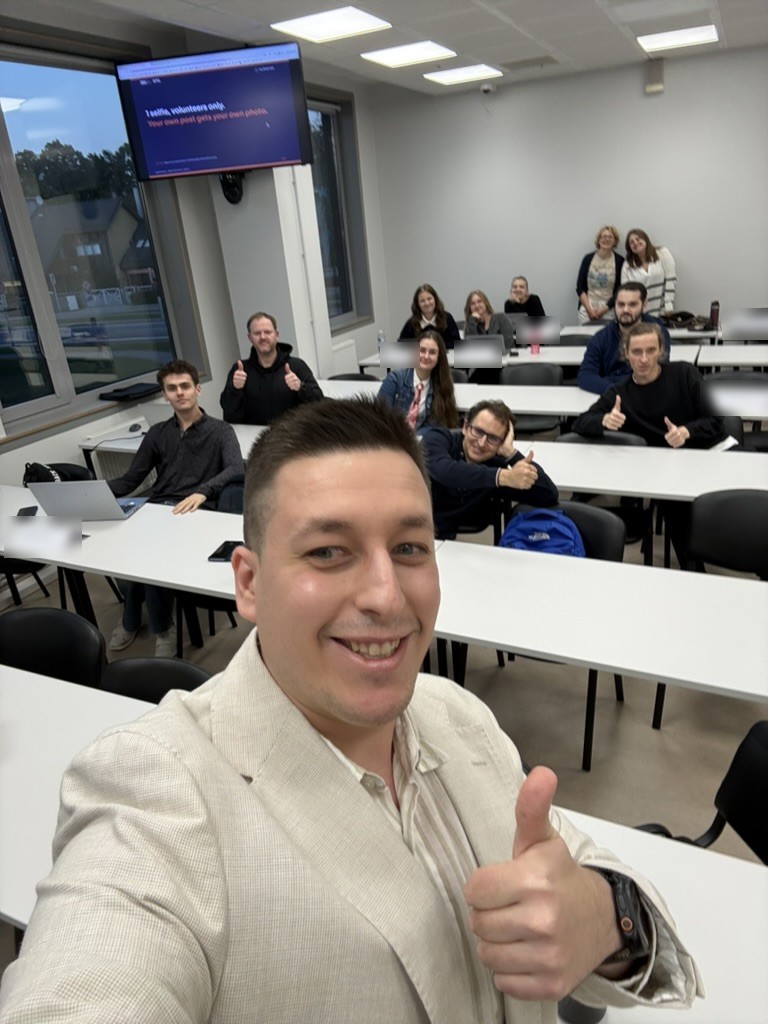
Headhunter for remote companies. I built a 32-person company with no office, and I have always worked remotely: from Shanghai, Bali, Kuala Lumpur and Rio de Janeiro, and now from Tallinn.
1,500+placements across Europe as a headhunter
120+remote professionals I hired myself as a founder
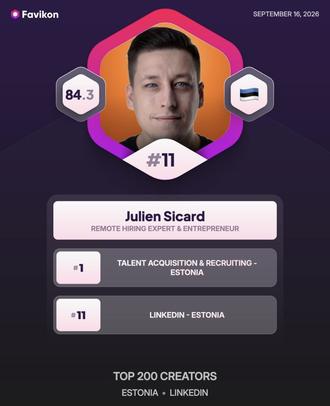
No. 1recruiting creator on LinkedIn in Estonia. Favikon, September 2026
Since 2018teaching in business schools, today on the MBA programme at Riga Business School
I know how remote companies search, who they call back, and why. In my experience it is rarely the person with the best CV. It is the person who knows how to sell what they do. That is what I want for the 10 people in this program: to sell themselves better, and get the remote job they dream of.

The life behind the job
What you are really applying for is freedom.
I work remotely. This is what it gives me, and what I want for you.
A 4-day weekend in Helsinki
If I want one, I take it. The work fits around my life.
My child is sick? I stay home
It changes nothing at work.
No commute
The hours you give to trains and traffic go back to you. Every single day.
A salary from London, a life where you choose
Your employer can be in London or New York while you live where life is good. I have worked from Shanghai, Bali, Kuala Lumpur and Rio de Janeiro. Today I choose Tallinn.
That freedom has 2 parts: a job that gives you the flexibility, and knowing how to land that job. In my experience, people get stuck on the second part. After 1,500+ placements, I know how these jobs are really filled. That is the key I give you.
The money
Wanting more money is fine.
In Europe we rarely say it out loud. I will. What a full-time job pays depends a lot on where the employer is, and with a remote job your employer can be in another country.
Bulgaria€15,400
Greece€18,000
Poland€21,200
Portugal€24,800
Spain€33,700
EU average€39,800
Germany€53,800
Ireland€61,100
Denmark€71,600
Luxembourg€83,000
5 timesThe average full-time salary in Luxembourg is more than 5 times the average in Bulgaria. Denmark's average is almost 4 times Greece's.
Same continent. A remote job lets you work for a company in a country that pays more, without moving there.
I can't promise you a number. Remote companies set pay in different ways, and some adjust it to where you live. In class 1 you decide your number. In class 3 you find the companies that can pay it. In class 4 you learn to ask for it.
Source: Eurostat, average annual full-time adjusted salary per employee, 2024. National averages across all jobs, rounded to the nearest 100 euros.
What changes in 2 weeks
In 2 weeks, you know how to sell yourself.
In my experience, people in Europe are good at their job and bad at selling it. That's what we fix: your positioning, your pitch and your message.
- Your positioning
“I'd take any remote job.”
You know the role, the salary and the conditions you want.
- Your pitch
“My profile looks like everyone else's.”
Your profile is rebuilt for remote hiring. In 3 seconds, a recruiter knows why you.
- Your message
“I apply to whatever shows up.”
You know which companies match your pay and your conditions, and what to write to the people who hire there.
- Your interview
“I hope they like me.”
You know what they want, you say it clearly, and you name your number.
The goal of these 2 weeks: a pitch so clear that remote companies chase you.
I work on all of it with you myself. That's why there are 10 seats.
Be first in line for the 10 seats
Inside the accelerator
4 classes. 8 hours. 1 pitch that sells you.
Each class builds 1 part of how you sell yourself. We work on yours, live.
- 1Week 1, Tuesday
Decide what you want, and what it pays
The role, the salary, the conditions. You put a number on what you want to earn, and we look at which remote roles can pay it.
- 2Week 1, Thursday
Your profile, rebuilt to sell you
I read profiles every day. I show you the line I read first, where I stop, and what makes me call someone. Then we rewrite yours.
- 3Week 2, Tuesday
The companies that fit you, and how to reach them
How to find remote companies that match your number and your conditions, and what to write to the founder or the recruiter. A headhunter fills roles with people who never applied. I show you how to become one of them.
- 4Week 2, Thursday
The interview that makes them want you
What a remote company needs to hear, and how to say it. Then the salary conversation with an employer in another country. We practise live.
Live, Tuesday and Thursday, 15:00 to 17:00 Tallinn time. Every class is recorded for the group.
Be first in line for the 10 seats
From people I taught
What people wrote after learning with me.
Recommendations on my LinkedIn profile, from people I taught.
“Julien is a very good instructor, very resourceful and his content was really helpful.”Paul Kyayise, on my LinkedIn profile
Lusine Aleksanyan
She recommends what I taught her for reorganising a profile so that search engines and people find it, whatever the goal, including finding a job.
Cecile Israel
She had already taken a profile class elsewhere, and writes that she still learned new things in mine.
Jean-Christophe Gaffier
He calls the method unique, and writes that applying it brought new insights to his own business.
 Taught by a headhunter with 1,500+ placements across Europe, ranked No. 1 recruiting creator on LinkedIn in Estonia by Favikon, September 2026.
 Webflow
 ElevenLabs
 GitLab
 Mozilla
 Docker
 Kraken
 Cohere
 PostHog